Helm
An AI that already knows what's next
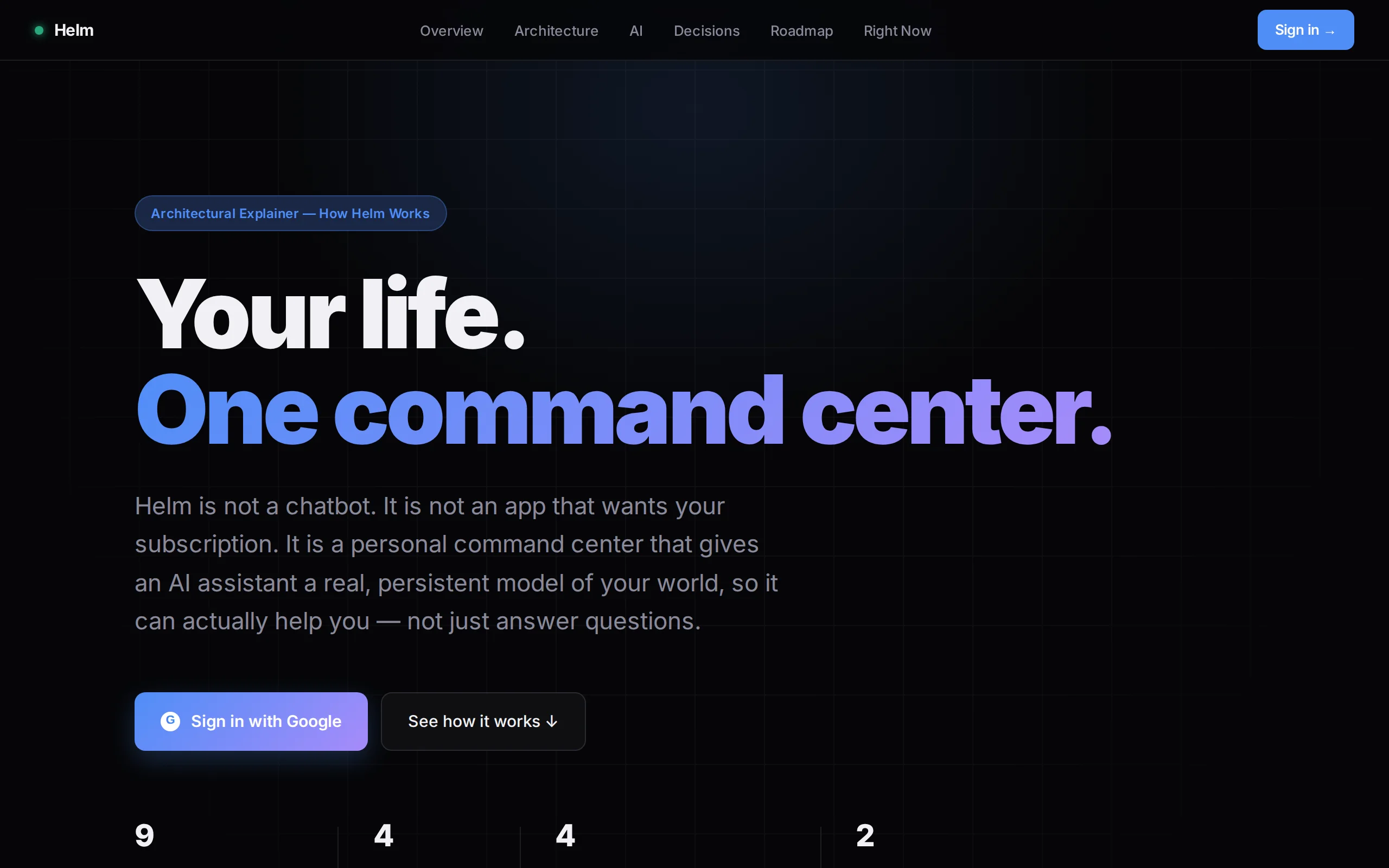
Most assistants forget you between chats. Helm doesn't. It reads your inboxes. It watches your calendar. It writes you a brief every morning before you ask. Same brain on your phone and your Mac. Real-time sync. Zero vendor lock-in. The AI shows up briefed — so you do too.
Most AI assistants forget you between chats. Helm doesn’t.
It reads four Gmail accounts and every calendar — live, not summarized. At 8:10 every morning it writes you a brief: what’s urgent, what shifted overnight, what needs to happen today. Again at midday. Again at end of day. You don’t prompt it. It briefs you.
Two surfaces, one brain. Open the web app on your phone for the today view, inbox, and chat. Switch to Claude Code on your Mac for deep work — writing code, drafting emails, planning the week. Check off a task on one, it’s gone on the other in seconds.
The memory isn’t in the model — it’s in your files. Narrative context lives as plain markdown in a git repo you own forever. Tasks and priorities live in your own Firestore database. Switch from Claude to Gemini to whatever comes next. Nothing breaks. ~$20/mo for Claude Code, free Firebase tier for everything else.
Reads four inboxes and every calendar
Live connection to Gmail and Google Calendar. Not snapshots, not summaries — the actual data. The AI knows what just landed in your inbox and what's on your calendar tomorrow.
Briefs you four times a day, on its own
Morning brief at 8:10. Midday triage at 1 PM. End-of-day reflection at 6 PM. Weekly review on Sunday evening. The AI scans, decides what matters, and writes the brief. You read what it sent.
One brain across phone and Mac
Web app on your phone for today view, inbox, and chat. Claude Code on your Mac for deep work. Same memory, real-time sync. Check off a task on one, it disappears on the other in seconds.
Built to survive any AI swap
Your context lives in markdown files in your git repo, plus your own Firestore database. Switch from Claude to Gemini to whatever comes next and nothing breaks. The memory isn't in the model.
Built for one operator
Single user, single Google account. No team workspaces, no audit logs, no collaboration features. An assistant that knows you — not a SaaS app trying to serve everyone.
Markdown for narrative, Firestore for fast-moving
Context, projects, decisions, evidence — plain markdown in git, owned by you forever. Tasks, priorities, ritual health — Firestore, synced in real time. Each thing lives in exactly one place.
The AI reads both layers, every time
Claude on your Mac and Gemini in the web app pull from the same context before they answer. They show up briefed, not blank. Memory survives the session.
Both surfaces stay in sync
Helm on your phone for inbox, calendar, today view. Cowork on your Mac for code, email, planning. Both write to the same store. No re-explaining what changed.
Is this open to other users?
No. Helm is a single-user app locked to one Google account. It's built around the assumption that one person — you — owns the entire context.
What happens if I want to switch AI providers?
Nothing breaks. The memory is in the markdown files (git) and Firestore — not in any AI model. Swap Claude for Gemini, Gemini for GPT, or use them all at once.
Where does my data live?
Markdown files: in a private git repo you control. Structured data: in your own Firebase Firestore project. No third-party SaaS holds your context hostage.
What's the difference between Helm and Cowork?
Helm is the web app — what you open on your phone or laptop for the today view, inbox, calendar, and chat. Cowork is Claude running natively on your Mac — it writes code, drafts emails, and plans. They share the same memory.